Contents
- 1. Start with a quiet, natural palette
- 2. Let natural wood do the heavy lifting
- 3. Hide visual clutter
- 4. Use open shelving carefully
- 5. Make small kitchens feel more spacious
- 6. Combine wood and stone
- 7. Keep hardware visually quiet
- 8. Bring Japanese principles into a modern kitchen
- 9. Use lighting for atmosphere
- 10. Create a deliberate transition between kitchen and dining
- 11. Add personality without visual noise
- 12. 32 ideas at a glance
Japanese-inspired kitchens have a reputation for feeling empty or severe, but that’s not really what makes them work. The calm comes from restraint rather than absence: natural materials used with intention, storage that keeps everyday objects out of sight, simple forms instead of ornate ones, and a layout that makes cooking and moving through the room genuinely easier.
None of that requires a full renovation or a particular kind of home. Whether your kitchen is large or compact, brand new or decades old, most of these ideas can be adapted in pieces — a palette shift here, a storage change there — without turning your kitchen into a showroom you’re afraid to use.
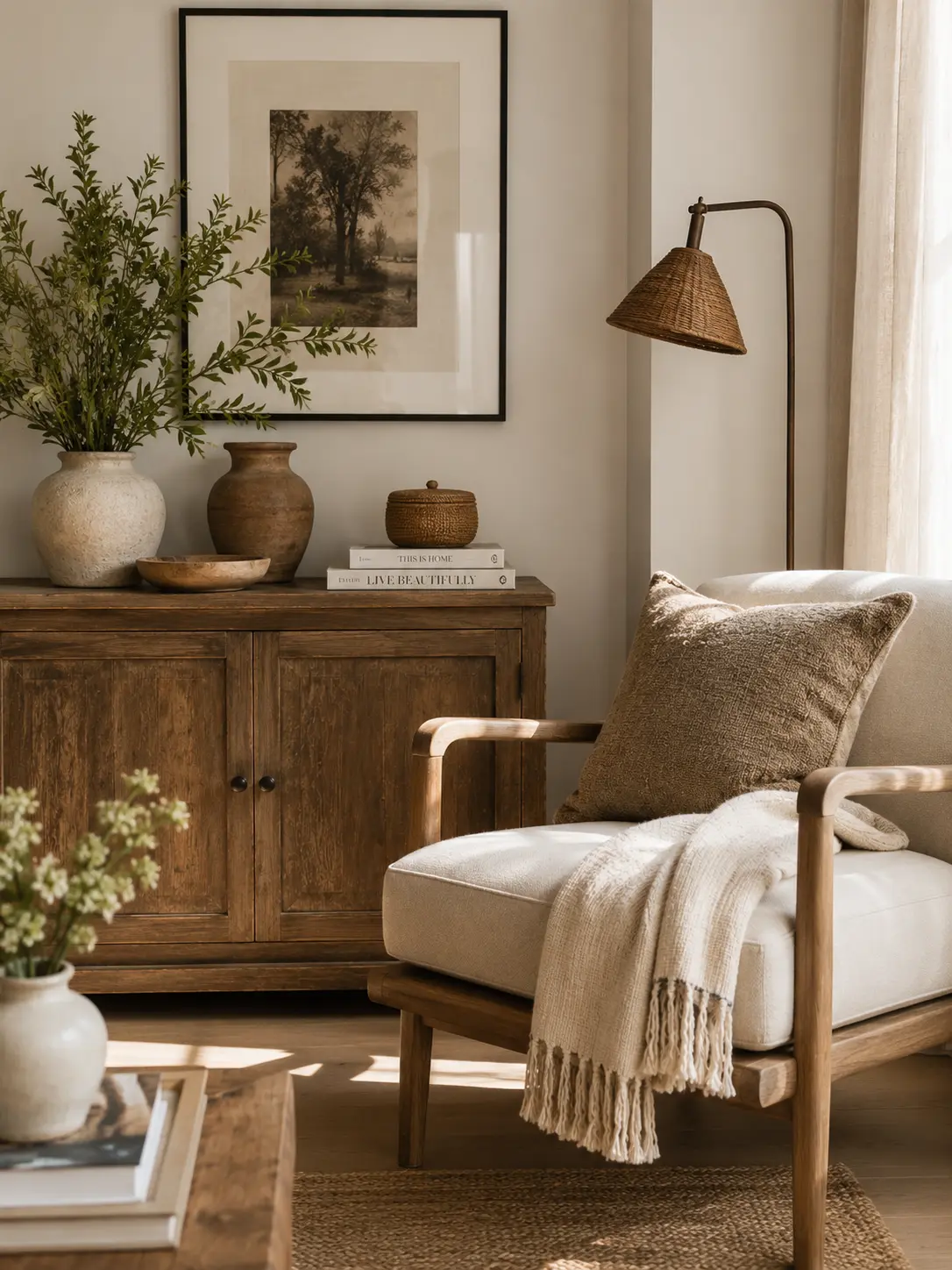
1. Start with a quiet, natural palette
The palette does more work than almost anything else in the room. Stark white and heavy contrast read as clinical; a Japanese-inspired kitchen leans on warmer, softer versions of the same neutrals so the space feels settled rather than sterile.
- Choose warm white over stark white for walls and ceilings, so the room feels soft rather than clinical.
- Use soft beige on the lower cabinetry to ground the room without adding visual weight.
- Let natural, unstained wood tones do most of the color work instead of paint or pattern.
- Keep contrast restrained — pair light surfaces with mid-tone wood rather than sharp black-and-white combinations.
2. Let natural wood do the heavy lifting
Once the palette is settled, wood becomes the main source of warmth and texture. It doesn’t need to be dark or rustic — light, straight-grained species read as contemporary and keep the room bright.
- Use light oak or ash for cabinetry fronts to bring warmth without darkening the room.
- Add a run of wood open shelving instead of another bank of cabinets.
- Extend the wood into the ceiling with a slatted or beamed detail overhead.
3. Hide visual clutter
A lot of what makes a kitchen feel busy isn’t decor — it’s the appliances, chargers, and daily-use items sitting out on the counter. Hiding them is one of the highest-impact changes you can make.
- Integrate the refrigerator and dishwasher behind matching cabinet fronts so the room reads as one continuous surface.
- Use full-height closed cabinetry for everyday dishware instead of stacking it in the open.
- Build in an appliance garage for the kettle, toaster, and coffee maker so the counter stays clear.
4. Use open shelving carefully
Open shelving is often the first thing people cut when a kitchen starts to feel cluttered — but used sparingly, it can add warmth instead of noise.
- Leave just one or two short runs of open shelving, not a whole wall of it.
- Style open shelves with a small, repeated set of ceramics rather than a mix of everything you own.
5. Make small kitchens feel more spacious
Japanese design has a long history of working with compact footprints, and a lot of that thinking translates directly to small kitchens.
- Run cabinetry in one continuous line so the eye doesn’t stop at seams and gaps.
- Keep a clear, unobstructed path between the main work zones.
- Choose lighter finishes on the largest surfaces — floors, walls, and the tallest cabinets.
- Reduce the number of visual interruptions, like handles, moldings, and mixed materials, to a minimum.
6. Combine wood and stone
Wood alone can start to feel one-note over a large kitchen. Stone adds texture and a sense of durability without breaking the palette, as long as the tones stay close.
- Pair a wood cabinet base with a honed stone or concrete-look countertop for texture without visual noise.
- Use a stone backsplash in a tone close to the wood, so the two materials read as a family rather than a contrast.
7. Keep hardware visually quiet
Hardware is small, but it’s one of the first things the eye catches on a cabinet front. Quiet hardware keeps the wood or paint as the main event.
- Choose slim, unobtrusive pulls in a matte finish rather than polished or oversized hardware.
- Use integrated finger-pulls or push-to-open fronts so some cabinets have no visible hardware at all.
8. Bring Japanese principles into a modern kitchen
You don’t need a traditional interior to borrow from Japanese design. A few well-placed references — proportion, materials, one considered detail — read as Japandi rather than costume.
- Borrow the low, horizontal lines of Japandi design with wide, flat-front cabinetry.
- Add a single shoji-inspired detail, like a frosted or slatted panel, without recreating a full traditional interior.
- Let a few imperfect, handmade pieces — a ceramic bowl, a raw-edge board — sit against the clean lines.
9. Use lighting for atmosphere
A single bright ceiling fixture flattens a room. Layered, warmer lighting is what makes a Japanese-inspired kitchen feel calm after dark, not just during the day.
- Layer a soft pendant over the island with recessed task lighting, instead of one central ceiling fixture.
- Add under-cabinet lighting so the counter is lit without brightening the whole room.
- Choose warm-toned bulbs so the wood and stone keep their natural color in the evening.
- Let some fixtures sit low, at eye level, for a softer, more residential feel than an all-overhead layout.
10. Create a deliberate transition between kitchen and dining
Open-plan kitchens can lose definition if the dining area just trails off. A small, deliberate transition keeps the spaces connected but still distinct.
- Use a low half-wall or open shelf to mark the edge of the kitchen without closing it off.
- Carry the same flooring or cabinetry tone into the dining area so the two spaces feel like one continuous room.
11. Add personality without visual noise
A kitchen this restrained can start to feel anonymous if nothing sets it apart. The trick is to add exactly one thing at a time, not several.
- Pick one material to be the “special” one — a stone island, a reclaimed beam — and let everything else stay quiet.
- Display a single meaningful object, like a favorite teapot or a piece of pottery, instead of full shelves of décor.
- Add one architectural feature, like a window seat or a sculptural light fixture, as the room’s one moment of drama.
12. 32 ideas at a glance
- Warm white walls instead of stark white
- Soft beige lower cabinets
- Natural, unstained wood tones
- Restrained contrast — no sharp black-and-white
- Light oak or ash cabinetry
- A run of open wood shelving
- Wood ceiling beams or slats
- Integrated fridge and dishwasher fronts
- Closed cabinetry for everyday dishware
- A hidden appliance garage
- Just one or two open shelves
- A small, repeated set of ceramics on display
- One continuous line of cabinetry
- A clear, unobstructed work path
- Lighter finishes on the largest surfaces
- Fewer visual interruptions overall
- Wood base with a stone countertop
- A stone backsplash close in tone to the wood
- Slim, matte hardware
- Push-to-open fronts with no visible pulls
- Low, horizontal cabinetry lines
- A single shoji-inspired panel
- A few imperfect, handmade pieces
- A layered pendant-and-task lighting plan
- Under-cabinet lighting
- Warm-toned bulbs throughout
- Some fixtures set at eye level
- A low half-wall between kitchen and dining
- Matching flooring or cabinetry tone carried into the dining area
- One “special” material as the star
- A single meaningful displayed object
- One architectural moment of drama
Pick two or three that fit your space rather than trying all thirty-two at once — the calm comes from restraint, so that’s the more Japanese-inspired way to use this list anyway.